


See:
Cause Hyaloperonospora parasitica (formerly Peronospora parasitica)(may also be called H. matthiolae), a fungus-like organism. Different strains infect different host such that downy mildew from stock will only infect stock. Moist or very humid conditions and temperatures from 50°F to 60F favor sporulation and disease development. Spores are dispersed by wind and splashing water. Spores germinate and infect when free water is present on the leaves.
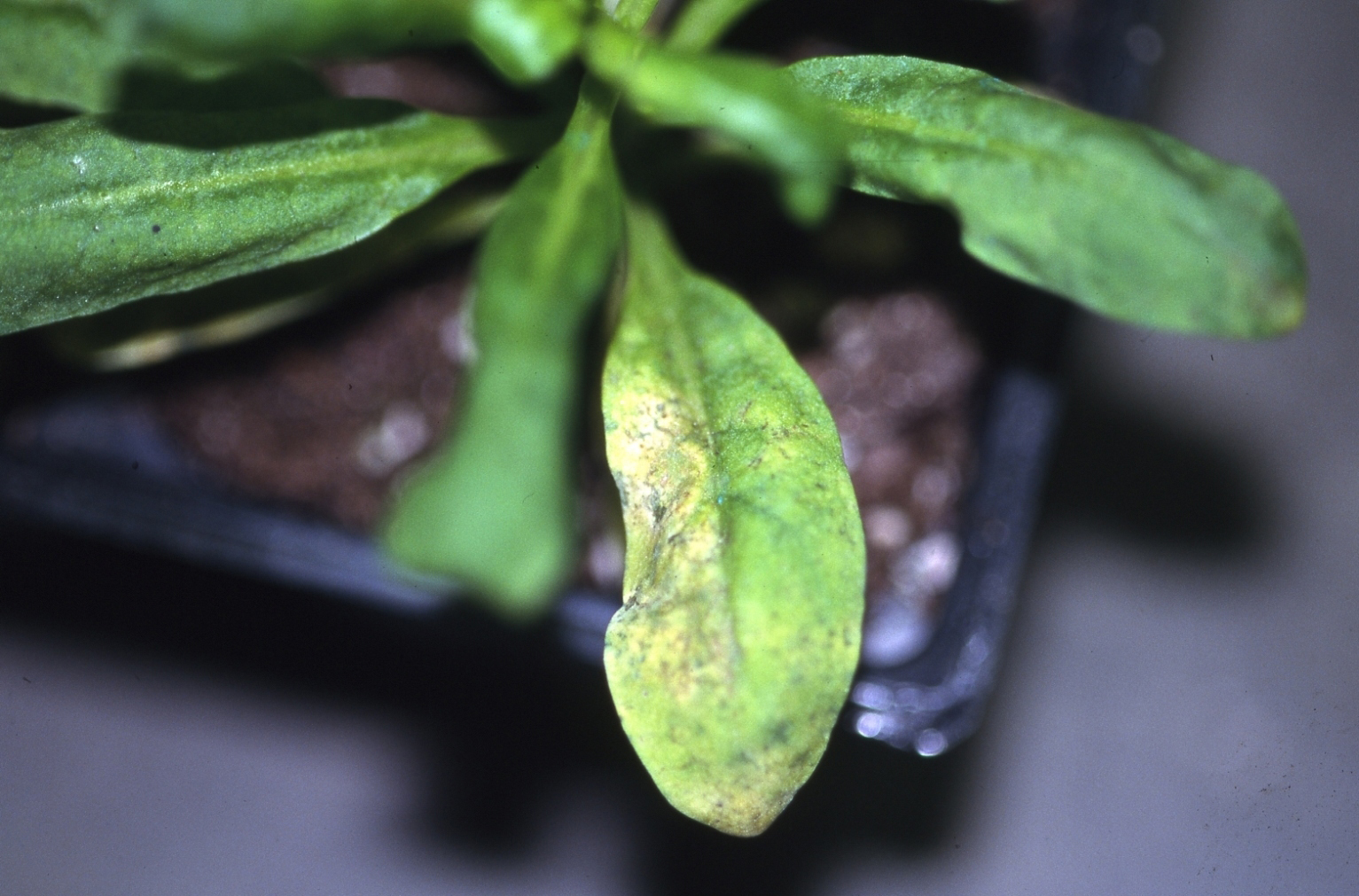
Symptoms Irregular, light green to slightly yellow, diffuse patches develop on the top of leaves. These areas increase and become more yellowed. Leaves may become twisted or turn brown and die. Sporulation may be seen on either side of the leaf under moist conditions and can occur before symptoms develop. Seedling can be killed from early infections.
Cultural control
- Water such that plants are not wet for extended periods of time.
- Remove and destroy infected plants.
- In the greenhouse, keep humidity as low as possible with fans and venting. Irrigate when leaves will dry quickly.
Chemical control Use before symptoms develop. Seed treatment can be helpful when the disease is a problem on seedlings. Alternate or tank-mix products from different groups that have different modes of action.
- Heritage at 2 to 4 oz/100 gal water. Group 11 fungicide. 4-hr reentry.
- KleenGrow at 12.5 fl oz/100 gal water. 48-hr reentry.
- Micora at 4 to 8 fl oz/100 gal water. Group 40 fungicide. 4-hr reentry.
- Orvego at 11 to 14 fl oz/100 gal water. Group 40 + 45 fungicide. 12-hr reentry.
- Stature SC at 6.12 to 12.25 fl oz/100 gal water. Group 40 fungicide. 12-hr reentry.
Reference Koike, S. T. 2018. Diseases of Stock. In McGovern, R.J., and Elmer, W.H. (eds.) Handbook of Florists' Crops Diseases. Springer Int.
Salgado-Salazar, C., Rodríguez Salamanca, L. M., Romberg, M. K., Davis, W. J., McConnell, M., Havan, A. E. and Peduto-Hand, F. 2025. Where Flowers Bloom, so Do Downy Mildews: New Species and New Records of Hyaloperonospora, Peronospora, and Plasmopara Species on Ornamental and Wild Plants in the United States. Plant Health Progress, 26:260-283.