

See:
Rhododendron - Phytophthora Root Rot
Cause Phytophthora spp. have been identified on rose samples with root rot from the PNW several times by the OSU Plant Clinic. These pathogens are fungus-like microorganisms and are also known as water-molds. Depending on the species, they can have a wide host range. Poorly drained, waterlogged soil or media, plastic ground covers, and excess irrigation favors these organisms. High soil moisture alone does not lead to disease, but water plays an important role in the spread of the disease. Phytophthora can survive unfavorable periods for many years as long-lived oospores or chlamydospores in plant debris or soil. The pathogen can be moved long distances on infected plants, as well as contaminated plant debris, potting media, pots, or water. Spores germinate and produce sporangia and a swimming spore stage called zoospores. Zoospores are produced in the greatest numbers under saturated conditions and are attracted to the fine roots where they attack and begin to rot the root system. After infection, the microorganism spreads, mainly in the inner bark tissues of the root and stems.
There are other root rot pathogens that have been diagnosed by the OSU Plant Clinic but at a much lower frequency. These genera include Armillaria, Cylindrocarpon, Fusarium, Rhizoctonia, and another water mold Pythium.
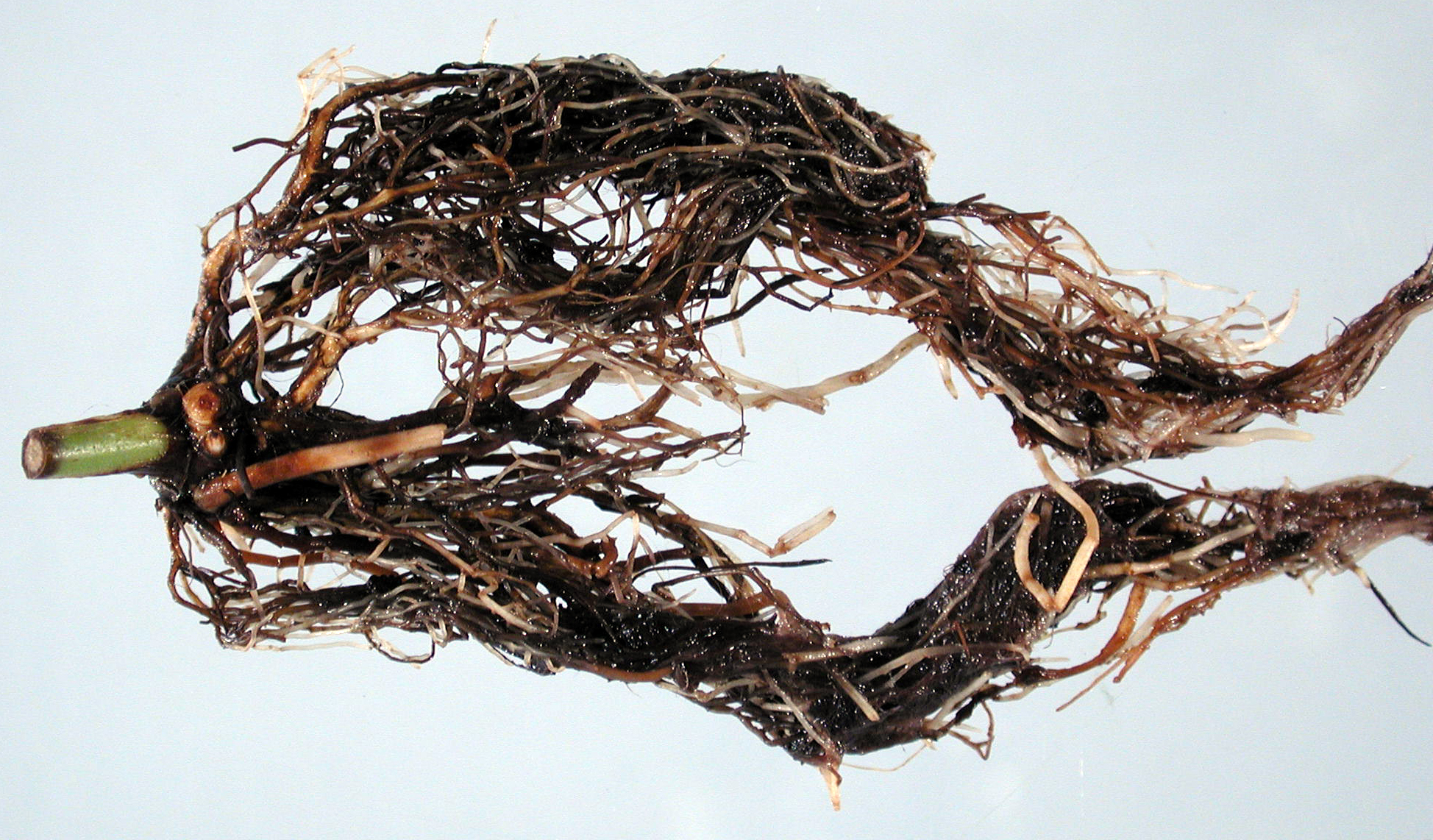
Symptoms The root rot of rose by Phytophthora has not been described well in the literature. On other plants, the fibrous roots rot first, turning brown or black, followed by the rest of the root system. Larger roots are present, but firm, with lesions in various shades from cinnamon-brown to dark black. The edge of the advancing lesion is distinct from adjacent, unaffected tissues which appear moist and light in coloration (white to green). Plants with severe root rot are weakly rooted, resulting in wobbly plants that are relatively easy to pull from the ground compared to adjacent healthy and well-rooted plants. Once a sufficient amount of the root system or stem is rotted, symptoms of nutrient deficiency and drought stress appear aboveground. Leaves may become yellowish- or reddish-green and eventually curl or wilt.
Stem blights due to various Phytophthora species have been characterized by water soaked, dark green to dark brown lesions at the bases of stems near the soil surface and leaf chlorosis, wilting and defoliation aboveground.
Cultural control Use many different tactics to manage root rots but focus efforts on water management.
- Quarantine new plants at least 1 year before setting them out in the production area. Examine and destroy any plants that show disease.
- Use pathogen-free cuttings.
- Provide good drainage for plants in beds, fields, or containers.
- Avoid areas of the field where drainage is poor or increase drainage with tiling.
- Rapid drainage of container media throughout the production cycle of the crop is critical.
- Use raised beds in landscape plantings.
- Use care in watering. If using a hose, take care not to splash, and keep the nozzle and hose off the ground, walkways, or other surfaces that may be contaminated.
- Keep benches and premises clean. Do not use sides of low benches as a footrest; soil on shoes may be contaminated. Keep walkways and areas beneath benches clean and free of plant debris.
- Clean all propagating tools with disinfectants.
- Use clean irrigation water.
- Reduce salinity of irrigation water and build-up of salts in root environment.
- Avoid reusing pots from a previous crop for propagation. If pots must be reused then wash off all debris and soak in a sanitizing solution or treat with aerated steam for 30 min.
Chemical control Use fungicides as preventative treatments. Rose may not be on all labels so try on a few plants first before wide spread use. Resistance to FRAC group 4 and P7 fungicides have been found in PNW nurseries. The Group 4 and Group P7 fungicides used to manage Phytophthora do not kill this organism. They can only prevent establishment of the organism before it gets into the plant. They can also prevent continued growth if the organism is already inside the plant thereby delaying symptoms that might have developed. Once chemical activity has subsided with time, the organism can resume growth within infected plants. Alternate or tank-mix products from different groups that have different modes of action. Limit the use of any one group during crop production.
- Soil drenches to help prevent root infection.
- Adorn at 1 to 4 fl oz/100 gal water plus another fungicide. Group 43 fungicide. 12-hr reentry.
- Banol at 2 to 3 oz/10 gal water. Registered for azalea only. Group 28 fungicide. 24-hr reentry.
- Banrot 40 WP at 6 to 12 oz/100 gal water. Group 1 + 14 fungicide. 12-hr reentry.
- Empress at 1 to 3 fl oz/100 gal water can be used for cuttings or seedlings. Group 11 fungicide. 12-hr reentry.
- Fenstop at 7 to 14 fl oz/50 to 100 gal water. Use 1 to 2 pints/sq ft. For greenhouse use only. Group 11 fungicide. 12-hr reentry.
- Fosphite at 3 quarts/100 gal water. Do not use copper products within 20 days of treatment. Group P7 fungicide. 4-hr reentry.
- Mefenoxam 2 AQ at 0.98 to 1.96 fl oz/100 gal water as a soil drench or at 1.23 to 2.45 fl oz/1,000 sq ft followed by at least 0.5 inch rain or irrigation. Reduce rates for all Azaleas, especially the cultivar Coral Bell. Group 4 fungicide. No restrictions on eentry when used as a soil drench or media incorporation.
- MetaStar 2E at 1 to 2.5 fl oz/100 gal water and apply as a drench. Group 4 fungicide. No restrictions on reentry when used as a soil drench or media incorporation.
- Monterey Garden Phos at 2 to 4 teaspoons/gal water as a foliar spray. Also labeled for soil drench, see label for details. Can be used in landscape sites. Group P7 fungicide. H
- Stature SC at 6.12 to 12.25 fl oz/50 to 100 gal water. Use as a drench. Group 40 fungicide. 12-hr reentry.
- Subdue MAXX at 1.25 to 2.5 fl oz/1,000 sq ft, irrigated in with 0.5 inch water within 24 hours. Group 4 fungicide. No restrictions on reentry when used as a soil drench.
- Terrazole 35 WP at 3.5 to 10 oz/100 gal water. Group 14 fungicide. 12-hr reentry.
- Truban 30 WP at 3 to 10 oz/100 gal water. Group 14 fungicide. 12-hr reentry.
- Foliage sprays of group P7 fungicides will be translocated down to the roots. Foliar sprays may not be as effective as soil drenches for some root Phytophthora root rot pathogens.
- Aliette at 2.5 to 5 lb/100 gal water. Do not use with adjuvants. 24-hr reentry.
- Areca at 2.5 to 5 lb/100 gal water as a foliar application. 12-hr reentry.
- Fosphite at 1 to 2 quarts/100 gal water. Do not use copper products within 20 days of treatment and do not use spray adjuvants. 4-hr reentry.
- OxiPhos at 1.3 to 4 quarts/100 gal water as a foliar spray. 4-hr reentry.
- Phospho-Jet is registered at 1 to 2 quarts/100 gal water as a foliar spray. Group P7 fungicide. 4-hr reentry.
- Sparra at 1 to 2 quarts/100 gal water as a foliar spray. Group P7 fungicide. 4-hr reentry.
References Salamone, A., Scarito, G., Pane, A. and Cacciola, S. O. 2011. Root and basal stem rot of rose caused by Phytophthora citrophthora in Italy. Plant Disease, 95:358.
Rahman, M. Z., Uematsu, S., Takeuchi, T., Shirai, K., Ishiguro, Y., Suga, H. and Kageyama, K. 2014. Two new species, Phytophthora nagaii sp. nov. and P. fragariaefolia sp. nov., causing serious diseases on rose and strawberry plants, respectively, in Japan. Journal of General Plant Pathology, 80:348-365.