
See:
Tomato (Solanum lycopersicum)- Fusarium Crown and Root Rot
Tomato (Solanum lycopersicum) - Fusarium Foot Rot
Tomato (Solanum lycopersicum) - Fusarium Wilt
Tomato (Solanum lycopersicum) - Varietal Resistance
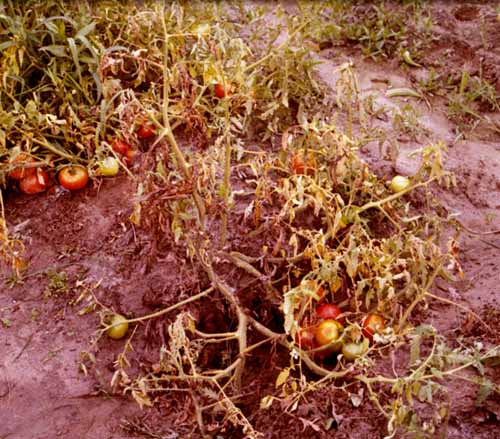
Cause Verticillium dahliae, a fungus that survives in soil and cause wilt symptoms. Verticillium survives in infected debris up to 8 years and is favored by cool weather (68°F to 75°F). Verticillium dahliae infects a wide range of weed and crop plants. This wilt fungus can be spread by infested equipment, transplants, and windborne or waterborne infested soil.
Symptoms Lower leaves yellow, mostly on one side. Plants wilt during the hot part of the day but recover in the evening. Eventually the leaves remain wilted, shrivel, turn brown, and die. The vascular system discolors. Growth is retarded, and yields are low. Can be confused with Fusarium foot rot.
Cultural control
- Use resistant varieties. They are marked with a V (for Verticillium resistance) Several V lines are available from seed companies.
- Home gardeners should remove and destroy all affected plant tissue, including roots.
- Rotating out of tomatoes 4 to 6 years may reduce losses, but success is not assured because the host range is so wide.
Chemical control
- Regalia Biofungicide (Group P5) at 1 to 3 quarts/100 gal water for soil drenches on 10- to 14-day intervals or at 1 to 4 quarts/A for in-furrow spray applications. Does not benefit from the addition of an adjuvant. 4-hr reentry. O
Biological control
- Bexfond at 7 to 28 fl oz/A. 4-hr reentry. O
- Stargus at 6 to 8 fl oz per 1,000 ft row as an in-furrow treatment, or 3 to 4 quarts/A as a soil drench (drip or chemigation) on 10- to 21-day intervals. Preharvest interval is 0 days. 4-hr reentry. O