
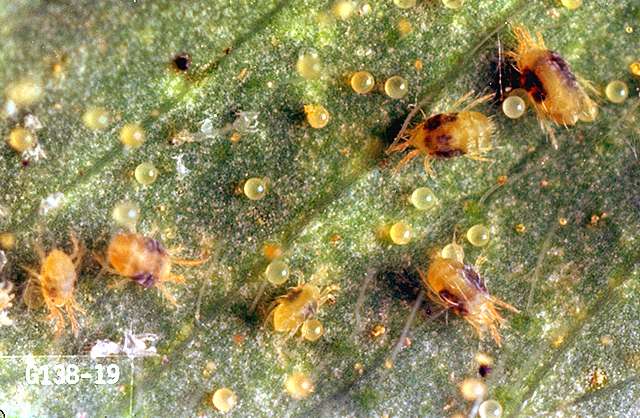
Tetranychus urticae
Pest description and crop damage Tiny, eight-legged, non-insect pests that suck plant juices from leaves and devitalize trees. Webbing accompanies heavy infestations. Undersides of leaves become yellow and silver where the mite colonies form, and later the entire leaf may bronze. Spider mites are common late in the growing season, and they sometimes reach populations that are high enough to cause major defoliation of the orchard. This problem is likely to increase with climate change if growing seasons continue to get hotter.
Management-biological control
Rain and cool temperatures tend to suppress mite populations. Considerable natural control is provided by lady beetles, particularly Stethorus species, and minute pirate bugs (Orius spp.). Predator mites, particularly Kampimodromus aberrans are important for managing populations of spider mite. Predator mites can be purchased and released within the orchard. This approach is much more feasible for home orchardists and small acreage hazelnut growers.
Management-cultural control
Spider mites thrive in dusty conditions; control dust on the orchard floor and on roads and headlands. Home orchardists: Mite populations can be physically reduced by spraying the tree with a strong stream of water. Population reductions may allow natural predators to gain control of an outbreak.
Management-chemical control: HOME USE
- azadirachtin (neem oil)-Some formulations are OMRI-listed for organic use.
- bifenthrin (often as a mix with other ingredients).
- insecticidal soap-Some formulations are OMRI-listed for organic use.
- plant-derived essential oils (ex. cinnamon oil, clove oil, peppermint oil, cottonseed oil)-Some formulations are OMRI-listed for organic use and have shown efficacy against spider mites.
- pyrethrins (often as a mix with sulfur)-Some formulations are OMRI-listed for organic use.
- sulfur (as a mix with pyrethrins)-Some formulations are OMRI-listed for organic use.
Management-chemical control: COMMERCIAL USE
Organic:
- azadirachtin (Aza-Direct) at 1 to 2 pints/A in 100 gal water. For best results reapply on 7- to 10-day interval. OMRI-listed for organic use. REI 4 hr.
- azadirachtin + pyrethrins (Azera) at 2 pints/A. OMRI-listed for organic use. PHI 1 day. REI 12 hr.
- insecticidal soaps-
- potassium silicate (Sil-Matrix) at 1 to 4 quarts/A in 100 gal water. REI 4 hr.
- potassium laurate (Des-X, others) at 2 gal/A in 100 gal water (2% solution). PHI 12 hr. Do not apply to drought stressed plants.
- pyrethrins 5% (PyGanic, Lynx) at 15 to 17 oz/A. No residual activity. PyGanic OMRI-listed for organic use. PHI 1 day. REI 12 hr.
- oils-Botanical and plant-derived oils including cinnamon oil (Cinnerate), neem (Rango and others), and peppermint (Mantis). Carefully follow labels to avoid phytotoxicity.
Conventional:
- abamectin (Agri-Mek, others) at 0.5 to 4.24 oz/A. PHI 21 days. REI 12 hr. Do not exceed two applications per season.
- acequinocyl (Kanemite 15 SC) at 21 to 31 oz/A. PHI 7 days. REI 12 hr. Aerial application prohibited, no less than 100 gal water should be used to apply. No more than 62 oz (0.6 lb ai) per season.
- bifenthrin-
- Brigade WSB at 0.05 to 0.2 lb ai/A. PHI 7 days. REI 12 hr. Do not graze livestock on treated cover crops. Highly toxic to bees and toxic to fish and aquatic invertebrates.
- Fanfare EC at 3.2 to 12.8 fl oz/A (0.05 to 0.20 lb ai/A). PHI 7 days. Do not graze livestock on treated cover crops. Highly toxic to bees and toxic to fish and aquatic invertebrates. WA only.
- bifenzate (Acramite 50 WS, others) at 0.75 to 1.5 lbs/A. PHI 14 days. REI 12 hr.
- etoxazole (Zeal) at 0.5 to 0.75 oz/100 gal water (2 to 3 oz/A). PHI 28 days. One application per season.
- fenpyroximate (Fujimite) at 2 pt/A. PHI 14 days. REI 12 hr.
- hexythiazox (Savey 50DF) at 3 to 6 oz/A. PHI 28 days. REI 12 hr. Does not significantly control adult rust mites. Apply at first sign of egg laying, before adult mites build up. Apply only once per season. Do not graze or feed livestock on cover crops growing in treated areas.
- pyridaben (Nexter) at 2.67 oz/100 gal water (10.67 oz/A). PHI 7 days. Do not exceed two applications per season.
- spirodiclofen (Envidor 2SC) at 16 to 18 fl oz/A. PHI 7 days. REI 12 hr.