
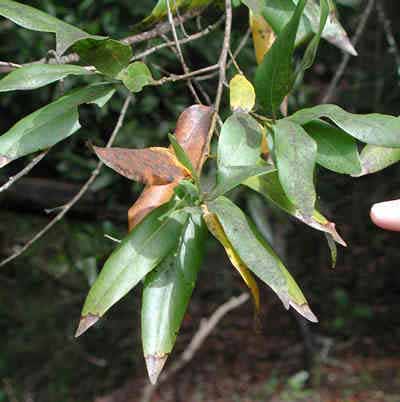
See:
Tanoak (Notholithocarpus densiflorus) - Sudden Oak Death
Notes A fungus-like organism, Phytophthora ramorum, killing tanoaks, wild rhododendrons, and evergreen huckleberry in a few isolated spots just north of Brookings, Oregon, was found during the summer of 2001. There was also incidental leaf spotting and tip dieback on myrtlewood and other plants. Federal and international quarantines have since been established to prevent the spread of this pathogen in soil and infected plant material. This plant is considered an important reservoir host that supports both prolific sporulation in the winter wet season and survival during the summer dry season. Over-summer survival was positively correlated with high percent canopy cover and lower summer temperatures.
References DiLeo, M. V., Bostock, R. M. and Rizzo, D .M. 2014. Microclimate impacts survival and prevalence of Phytophthora ramorum in Umbellularia californica, a key reservoir host of sudden oak death in northern California forests. PLoS One, 9(8), p.e98195.