

See:
Seed Crop, Crucifers (Brassica, Eruca, and Raphanus spp.) - White Rust
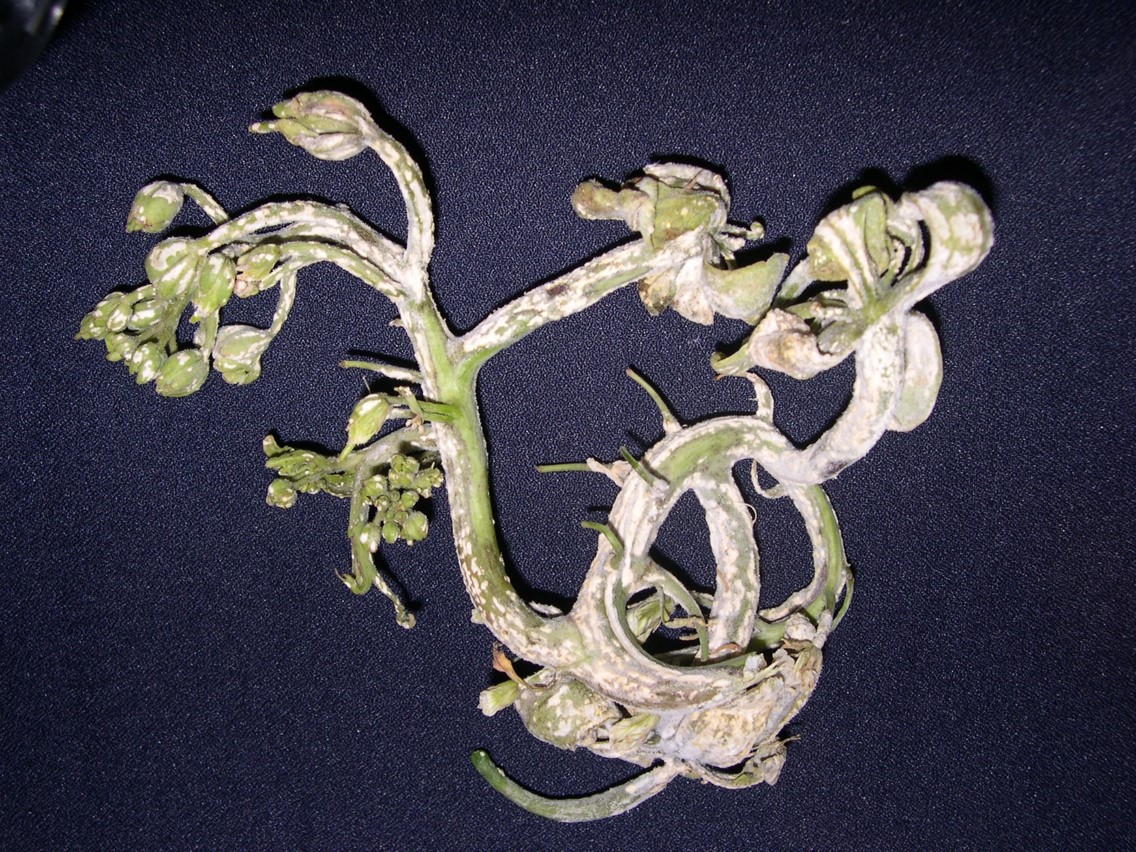
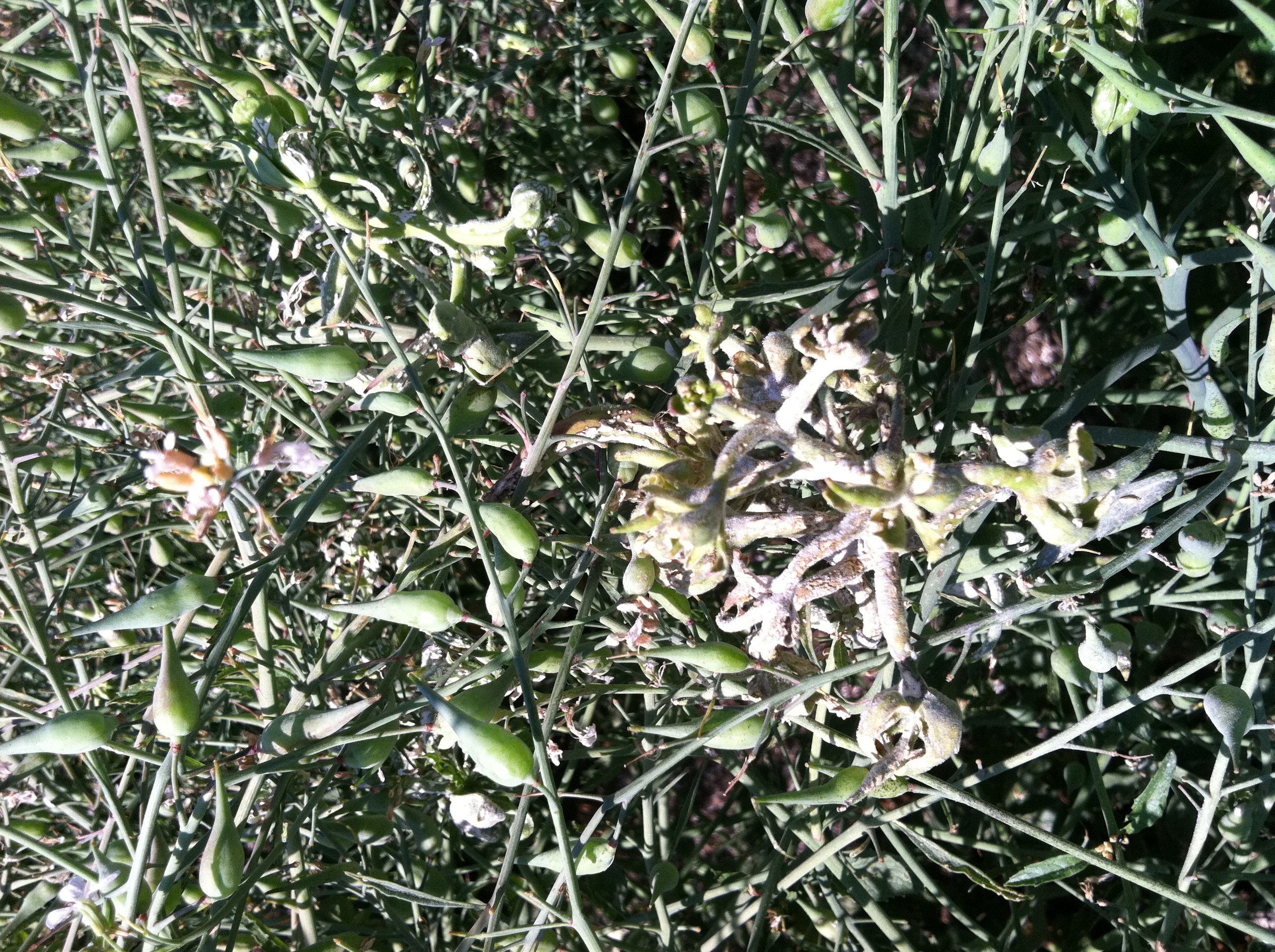
Cause Albugo candida, a fungus-like microorganism, can cause disease on crucifers in general including radish, rapeseed (canola), horseradish, arugula, leafy brassicas, head and stem brassicas, and wild mustards. In the Pacific Northwest, white rust can be severe on radish seed crops. Most round, red varieties and some daikon selections are susceptible. The pathogen overwinters as oospores in stagheads (galls formed on infected seed heads) or plant debris as well as mycelium in infected hosts. Pieces of staghorns are often found as seed contaminants and can be the primary source of infection in a field. The oospores can germinate and infect young plants, leading to pustules on leaves. Sporangia are produced in pustules and can be moved by wind, rain, or insects. Sporangia germinate, giving rise to zoospores. Zoospores are motile; they swim for a short distance and then invade the plant by germinating through the stomata. Sporangia require some drying in order to germinate but disease development is favored by moist conditions and temperatures between 50°F and 77°F. Dew, fog, or periods of extended rainfall and cool temperatures are ideal for zoospore activity. White rust often occurs alongside downy mildew.
Symptoms First symptoms may appear as small, light green spots, which later turn white or cream-colored and finally result in blister-like raised white pustules usually on the lower leaf surface. Severely affected leaves may defoliate. Pustules can develop on the upper or lower leaf surfaces or on stems and consist of masses of sporangia. Systemic infections can occur, causing the aboveground portion of young seedlings to be distorted and appear abnormally shaped. Swellings can also occur on storage roots.
Cultural control
- Plant only seed grown in white rust-free plantings.
- Avoid overhead irrigation.
- Practice a 3-year rotation between susceptible crops.
- Select field sites away from established crucifeous crop fields.
- Control wild mustards around the field.
- Plant resistant varieties. Red varieties with resistance to white rust include Autella, which also has resistance to downy mildew.
- Plow under infected plants or volunteers and incorporate plant debris into soil soon after harvest.
Chemical control Seed treatment minimizes spread through contaminated seed.
- Captan 4F (Group M4) at 2.2 fl oz/100 lb seed plus a dye.
- 42-S Thiram (Group M3) at 8 fl oz/100 lb seed plus a dye. See label for reentry restrictions.
Use systemic fungicides at planting. To minimize development of resistant fungi, do not make foliar applications for other diseases if Ridomil is used at planting. Do not use in the greenhouse. Ridomil is not registered in British Columbia.
- Ridomil Gold Copper (Group 4 + M1). See label for rates. Do not apply within 7 days of harvest. 48-hr reentry.
Spray applications after planting, especially if dews or rainy weather are forecasted.
- Badge SC (Group M1) at 1 to 2.25 pints/A on 10-day intervals. Preharvest interval is 0 days. 48-hr reentry.
- Ridomil Gold Copper (Group 4 + M1) at 1 to 2 lb/A on 14-day intervals. Preharvest interval is 7 days. 48-hr reentry.
- Strobilurin fungicides (Group 11) are labeled for use. Do not make more than one (1) application of a Group 11 fungicide before alternating to a labeled fungicide with a different mode of action.
- Cabrio EG at 8 to 16 oz/A on 7- to 14-day intervals. Studies by OSU showed a significant reduction in the percentage of diseased plants when Cabrio was used compared to nontreated plants (62% vs 2%) under late onset of disease. Preharvest interval is 0 days. 12-hr reentry.
- Quadris Flowable at 6 to 15.5 fl oz/A on 7- to 14-day intervals. May be applied day of harvest. 4-hr reentry.
- Satori at 6 to 20 fl oz/A on 7- to 14-day intervals. Preharvest interval is 0 days. 4-hr reentry.
References Johnson, D.A. 1990. White Rust of Seed Radish. WSU Extension Service EB1570.
Ocamb, C.M., Buckland, K., and Bates, T.A. 2019. Evaluation of materials for foliar diseases on radish in Oregon, 2018. Plant Dis. Manage. Rep.: Rep. No. 13:V094.