
The bacterium Xylella fastidiosa and the diseases it causes have been periodically in the news. New vectors or geographic areas with the disease results in new quarantines. In the 1990s, the glassy-winged sharpshooter was found to vector the bacterium to grapes and other crops extending the range of Pierce’s disease. The pathogen is native to the western hemisphere so it was alarming in 2013 when it was found killing ancient olive trees in Europe. Nurseries shipping plants from the PNW to Europe needed to know if their county was free of Xylella. (X. fastidiosa has since been found on 174 hosts and is established in a few European countries such as Italy, France, Portugal and Spain).
Xylella fastidiosa is a bacterial plant pathogen that colonizes plant xylem vessels leading to desiccation of the plant. There are three supported subspecies (X. f. subsp. fastidiosa, multiplex, and pauca) and two which are still debatable (morus and sandyi). Genetic analysis continues to uncover new strains, which differ in terms of infectivity, growth rate, within-host movement rate, and symptom severity. This pathogen is transmitted exclusively by xylem feeding insects, such as leaf hoppers and sharpshooters, in a semi-persistent relationship. The bacteria colonizes and persists in the foregut of the insect but is not transmitted between insect life stages.
There are more than 500 host plant species, where it can be a harmless endophyte, or cause severe disease. The variability of host plants matches the high genetic diversity of this pathogen, of which different subspecies and strains display a loose host specificity. Important hosts attributed to X. f. subsp. fastidiosa include grape and coffee; to X. f. subsp. multiplex include many woody plants such as elm, maple, oak, sycamore as well as blueberry, olive and peach; to X. f. subsp. pauca include almond, citrus, coffee and olive; X. f. subsp. morus include mulberry; and X. f. subsp. sandyi include oleander.
Symptoms are caused by the bacterial production of a biofilm and defense structures by the plant so that water movement in the xylem is restricted and the plant progressively desiccates. Symptoms can vary in intensity depending on host species, pathogen genotype, environmental conditions, and host−bacterium association. After inoculation, infected plants can remain asymptomatic from 2 to 3 months, as in the case of Pierce’s disease of grape, to 14 months as in olive quick decline, depending on biotic and abiotic conditions.
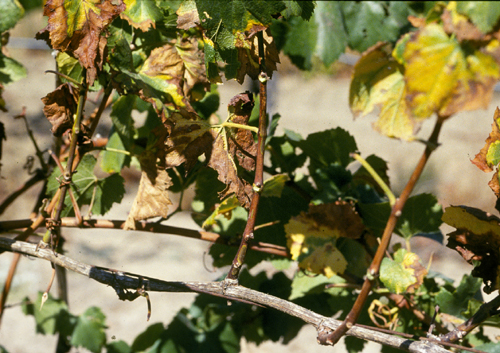
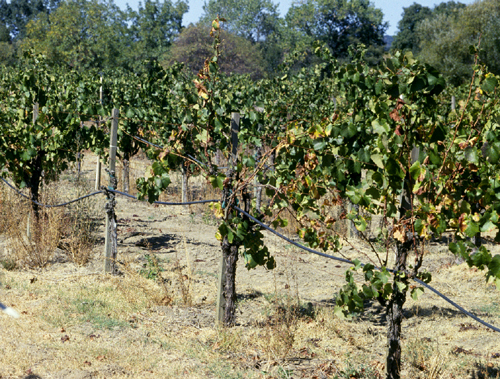
Symptoms caused by X. fastidiosa infection are nonspecific, mostly general indications of water stress, such as drying of leaf margins, scorched leaves, and wilting. The annual summer drought of the PNW complicates diagnosis of these diseases. Plants under water stress from other causes will display symptoms that are similar if not exactly like diseases caused by X. fastidiosa. These stresses include prolonged regional drought, excessive and/or sudden high temperatures, or by overfertilization resulting in salt accumulation in the leaves. Common root rot diseases can also result in similar aboveground symptoms.
Diseases of concern for the PNW include Pierce’s disease of grape which is under quarantine regulations. Other plants of concern for the PNW include those with common leaf scorch symptoms such as dogwood, horse-chestnut, lilac, linden, maple, oak, Oregon grape, poplar and sycamore.
Pierce’s disease of grape, (Xylella fastidiosa subsp. fastidiosa), is not known to be in the Pacific Northwest. Our climate may be too cold for the pathogen to survive. Infected grapevines do not retain the pathogen after a cold dormant-season typical of continental climates. Several glassy-winged sharpshooter vectors were found near western Oregon ornamental nurseries in 2000. An extensive survey that fall of 291 samples from vineyards, native hosts, and nurseries did not find any evidence of the causal bacterium. Surveys of Washington grapes by WSDA in 2017 also did not detect this bacterium.
Many perennial trees and shrubs show leaf scorch symptoms in the PNW. Maple leaf scorch symptoms include necrosis of leaf margins and areas between veins. Symptoms can be severe in areas east of the Cascades when bright, hot days follow cool, moist weather during leaf emergence. With oak leaf scorch, leaf edges turn bronze, then later brown and dry. In severe cases, the scorch on oak leaves may spread to areas between veins or entire twigs may die back. Sun or heat related stress will occur primarily on the south side of plants. In the southeastern United States, X. fastidiosa has been associated with these same symptoms in red maple and oak as well as elm and sycamore.
Statewide surveys of native vegetation in Washington from 2017 to 2019 by the WSDA found Xylella fastidiosa subsp. multiplex in Lonicera spp. (honesuckle), rose, Salix spp. (willow) and Sambucus spp. (elderberry). Initial serological tests (ELISA) are always followed up with molecular tests (PCR). Subspecies typing was based on a molecular assay called multilocus sequencing. The bacterium was not found in buffer zones around exporting nurseries or in any commercial crops.
There have been false positive detections for this bacterium in the PNW with serious ramifications. For example, in November 2015, laboratory tests from several pear trees at the USDA Germplasm Repository in Corvallis, Oregon were positive for Xylella fastidiosa. Oregon Department of Agriculture subsequently imposed an emergency quarantine restricting the movement of certain plant materials within the state, and the USDA gene bank suspended distribution of dormant Pyrus scionwood for calendar year 2016. However, in 2016, trace-back surveys of pear germplasm recipients in Oregon and Washington, and surveys of multiple potential Xylella hosts in the Corvallis area, failed to detect any evidence that Xylella fastidiosa was present.
The issue of Xylella in the PNW is clearly important and in need of more study. New finds on Quercus spp. in 2020 bring up unanswered questions of testing, spread and regulatory implications. Longer term climatic drought combined with the annual summer drought has resulted in many symptomatic plants. This climate change may alter the geographic distribution of this bacterium. Monitoring for it in the PNW remains an important activity.
References
Baldi, P. and La Porta, N. 2017. Xylella fastidiosa: host range and advance in molecular identification techniques. Frontiers in Plant Science, 8:944. https://doi.org/10.3389/fpls.2017.00944
Gould, A. B. and Lashomb, J. H. 2007. Bacterial leaf scorch (BLS) of shade trees. The Plant Health Instructor. APSnet Feature, St. Paul, MN. 18p.DOI: 10.1094/PHI-I-2007-0403-07
Harris, J. L., Di Bello, P. L., Lear, M. and Balci, Y. 2014. Bacterial leaf scorch in the District of Columbia: Distribution, host range, and presence of Xylella fastidiosa among urban trees. Plant Disease, 98:1611-1618.
Lieth, J. H., Meyer, M. M., Yeo, K. H. and Kirkpatrick, B. C. 2011. Modeling cold curing of Pierce’s disease in Vitis vinifera ‘Pinot Noir’ and ‘Cabernet sauvignon’ grapevines in California. Phytopathology, 101:1492-1500.
Occhibove, F., Chapman, D. S., Mastin, A. J., Parnell, S. S., Agstner, B., Mato-Amboage, R., Jones, G., Dunn, M., Pollard, C. R., Robinson, J. S. and Marzano, M. 2020. Eco-epidemiological uncertainties of emerging plant diseases: the challenge of predicting Xylella fastidiosa dynamics in novel environments. Phytopathology, 110:1740-1750.
Trkulja, V., Tomić, A., Iličić, R., Nožinić, M. and Milovanović, T. P. 2022. Xylella fastidiosa in Europe: From the introduction to the current status. The plant pathology journal, 38:551-571.
Wilcox, W. F., Gubler, W. D. and Uyemoto, J. K. 2015. Compendium of grape diseases, disorders, and pests. Second edition. St. Paul, MN: APS Press.