
See:
Peony (Paeonia spp.) - Stem Rot
Petunia (Petunia spp.) - Stem Rot
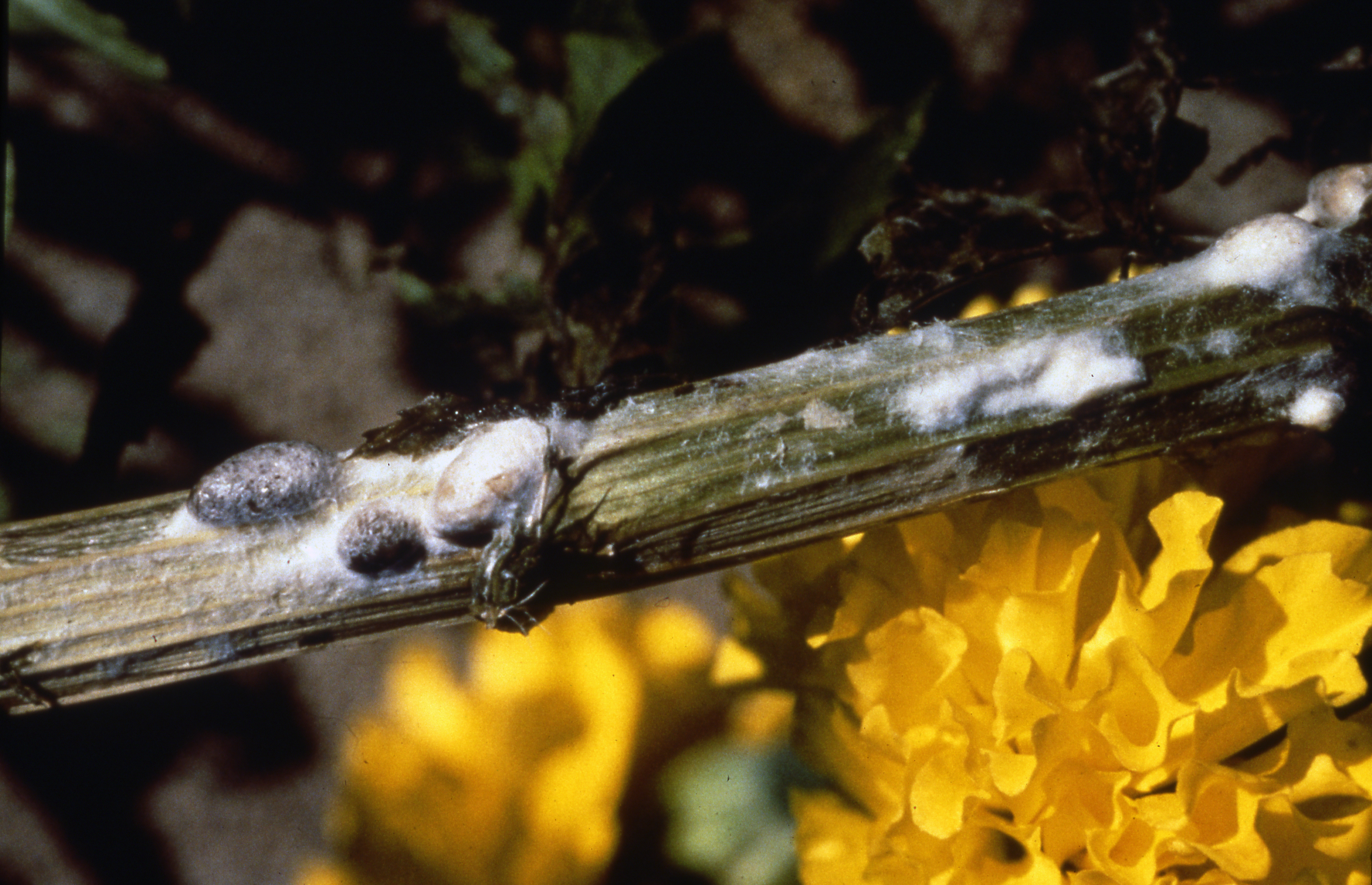
Cause Sclerotinia sclerotiorum, a fungus that produces hard, black sclerotia, can survive many years in soil. These structures may be produced either on or inside the plant tissues. Sclerotia germinate to form hyphae that may attack plant stems, roots and flowers or produce apothecia that contain sexual dispersal spores in the spring. The disease develops in cool, wet conditions and is more prevalent when plants form a complete, compact canopy that holds high relative humidity. The fungus can colonize dead organic plant matter and survive many years.
In the potato system, flowers are very susceptible to infection and are the main source of stem infection. Infected petals fall onto stems allowing the fungus to gain entry into the stems. Direct penetration of stems, in contact with the soil, from germinating soilborne sclerotia also occurs.
Symptoms Flowers rot and get covered with fluffy white mycelia. Symptoms may first appear on petals and then progress to the rest of the flower and the lower portions of the plant. Infected plant parts first turn dark green and usually appear watery or greasy. Dark brown lesions develop on infected leaves and stems, while severely infected plants show flower drop and wilting of branches.
Cultural control
- Use a soilless medium or pasteurized soil to start seedlings mix with a pH of 6 to 6.6.
- Space plants for good air circulation.
- Avoid overhead irrigation or any practice that keeps plants wet for extended periods of time.
- Remove and destroy infected plants as soon as they are found.
- Clean up and remove crop debris promptly at the end of the growing season.
- Rotate with less susceptible crops such as alyssum, daffodil, salvia, pansy, or ornamental grasses. Resistant crops include rushes, sedges, and the fountain grass Pennisetum glaucum.
- Avoid reusing pots or trays from a previous crop for propagation. If pots must be reused then wash off all debris and soak in a sanitizing solution or treat with aerated steam for 30 min.
Chemical control for seedlings. Some fungicides applied to flowers have worked well in vegetable systems where the epidemiology is better understood. The following materials may provide protection; however, few ornamental trials have been done to demonstrate the best timing.
- Astun at 10 to 17 fl oz/100 gal water. Group 7 fungicide. 12-hr reentry.
- Broadform at 4 to 8 fl oz/100 gal water. Group 7 + 11 fungicide. 12-hr reentry.
- Chipco 26019 FLO at 1 to 2.5 quarts/100 gal water. Group 2 fungicide. 12-hr reentry.
- Decree 50 WDG at 0.75 to 1.5 lb/100 gal water. Group 17 fungicide. 12-hr reentry.
- Fore 80WP Rainshield at 1.5 lb/100 gal water. Do not use on French dwarf-double or signet-type marigold seedlings. 24-hr reentry.
- Medallion WDG at 2 to 4 oz/100 gal water. Using with oils or adjuvants may damage plant. Group 12 fungicide. 12-hr reentry.
- OHP 6672 4.5 F at 10 to 14.5 fl oz/100 gal water plus another fungicide. 12-hr reentry.
- Orkestra at 8 fl oz/100 gal water. Group 7 + 11 fungicide. 12-hr reentry.
- Pageant at 12 to 18 oz/100 gal water. Do not use with organosilicone-based adjuvants. Group 7 + 11 fungicide. 12-hr reentry.
- Palladium at 4 to 6 oz/100 gal water. Avoid excessive runoff to small plants, which may result in stunting and/or chlorosis. Group 9 + 12 fungicide. 12-hr reentry.
- Phyton 27 at 1.3 to 2 oz/10 gal water. Group M1 fungicide. 48-hr reentry.
- Postiva at 10 to 28 fl oz/100 gal water. Group 3 + 7 fungicide. 12-hr reentry.
- Spirato GHN at 2 to 4 fl oz/100 gal water. Use with oils or adjuvants may cause plant damage. Group 12 fungicide. 12-hr reentry.
- Switch WG at 11 to 14 oz/A. Do not use within 7 days of harvest. Group 9 + 12 fungicide. 12-hr reentry.
- Terraguard SC at 4 to 8 fl oz/100 gal water. Group 3 fungicide. 12-hr reentry.
Biological control
- Contans WG (Coniothyrium minitans strain CON/M/91-08) at 1 to 4 lb/A. Spray soil surface and then incorporate 1 to 2 inches with water or disc. Less effective in soils over 85°F and under 35°F. 4-hr reentry. O
References Shome, A., Ahmmed, A. N. F. and Zaman, R. 2024. Assessing the Incidence and Severity of Field Diseases in Marigold (Tagetes erecta) Cultivation: Results from Jashore District, Bangladesh. bioRxiv, pp.2024-10.