

See:
Cherry (Prunus spp.) - Bacterial Canker
Diseases Caused by Pseudomonas syringae
Cause Pseudomonas syringae pv. syringae, and P. amygdali pv. morsprunorum, bactera. (Note that in France bacteria from four different phylogroups were able to induce canker.) Although bacterial canker is more serious on sweet cherry trees, it also affects almonds, apricots, peaches, plums, and prunes. This disease is common on apricots planted west of the Cascade range. In Europe, bacterial canker is one of the most important diseases of apricot in regions with spring frost conducive for disease development.
Although the bacteria survive on the outside of the plant they must get inside and multiply in the space between plant cells (apoplast) to cause disease. These pathogenic bacteria inject several proteins and small-molecule toxins to get past host immune mechanisms. Once inside, the bacteria induce a watery, nutrient rich environment between the plant cells where they can multiply and continue colonization of the plant tissues. Bacteria also produce a protein that acts as an ice nucleus, increasing frost wounds that bacteria easily colonize and expand. Factors that weaken or injure the tree predispose it to developing cankers. These factors include wounds, frost damage, early dormant season pruning, heading cuts, incorrect soil pH, and poor nutrition. Important avenues of infection leading to tree death include natural leaf scars in the fall and heading cuts made in the spring after planting a new orchard. Infection by other pathogens including Cytospora, Verticillium, and Nectria can lead to more bacterial canker. Ring nematodes have also been associated with increased susceptibility to bacteria canker in both cherry and peach. Sources of bacteria include old cankers, healthy buds, systemic infections within trees (with or without cankers), as epiphytes on leaf surfaces, weeds, grasses, and even soil. Wind, rain, insects, infected bud wood, and infected nursery stock can spread bacteria. Pruning through cankered and then through susceptible, healthy tissue does not spread the disease.
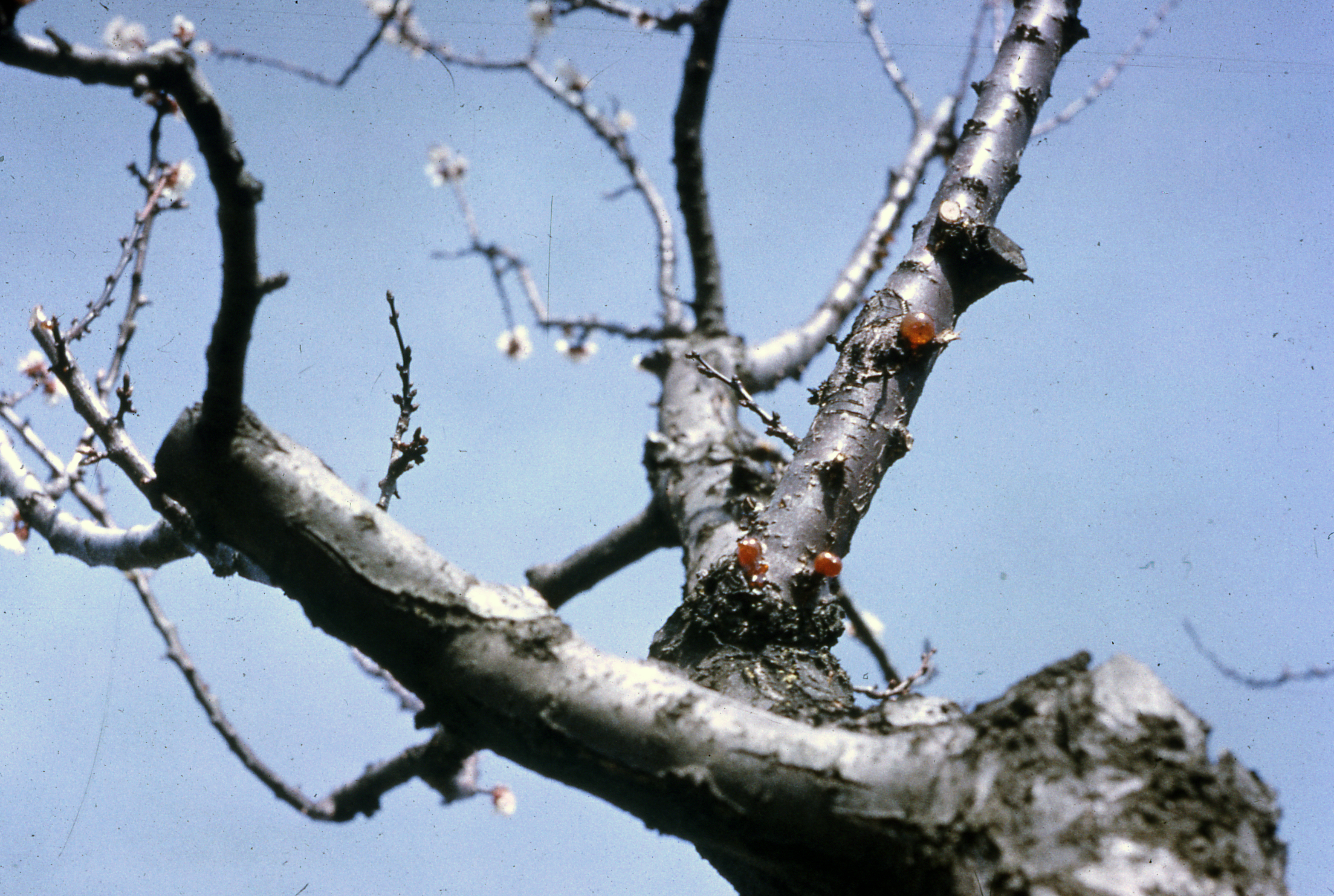
Symptoms The most conspicuous symptoms are cankers, gum exudation, and dieback of girdled branches. Dead buds and leaf spots also can occur. In most cases, heavy gumming is associated with bacterial canker formation on branches and twigs. Gumming occurs at the cankers' margins. Cankers may occur on the trunk, limbs, and twigs. Typical cankers are much longer than broad, but a canker may girdle the infected limb or trunk. The cambium at the canker will be discolored and necrotic. Use a pocket knife to reveal this discolored tissue. Cankers develop in winter and early spring. As the tree begins growth in spring, the bacteria population declines and a callus layer forms around the canker's edge. During spring and summer, girdled and nearly girdled limbs may leaf out. Normally, leaves turn yellow, then the limbs usually die. In some instances, these symptoms may not appear until late summer when the leaves' water requirement is high. Leaf spots are common on apricot and are at first water soaked, then become dry and brown.
Cultural control Bacterial canker is best managed through the use of many different tactics.
- Do not interplant new trees with old trees, which are a major source of the bacteria.
- Locate orchard in an area less likely to be affected by frost. If planting in the spring, plant orchards after date that frost is likely to have occurred. Prevent winter injury by painting trunks white and avoiding late season fertility.
- Test soil for ring nematodes before planting. Also test for pH and other physical characteristics that can be corrected prior to planting.
- Provide optimal soil conditions for growing apricots including attention to pH and nutrition. Annually monitor for adequate nutrient levels such as nitrogen. Keep irrigation off above ground parts for the first few years.
- Control weeds.
- Delay dormant pruning until January or February. Summer pruning is even better and should be after harvest, when weather is dry. Make heading cuts after planting only during dry weather when rain will not occur for at least a week after pruning. Make heading cuts close to a lateral bud.
- Completely remove infected trees or branches girdled and killed by cankers. Do not allow trees to regrow from roots or trunks left after a major trunk canker has been removed.
- In summer, small cankers may be cut out using the following method. Cut away bark above and around the edges of the infected area. Use sharp tools, and leave wound margins smooth and neat. Wounds should be left uncovered to dry out during the summer. Try not to have sprinkler irrigation soak the wounds. Sterilize all pruning tools between cuts with an appropriate disinfectant.
- Cauterizing cankers using a hand-held propane burner has been used with some success in New Zealand.
Chemical control Copper-based products have not worked well under conditions favorable for disease development. Bacteria resistant to copper products have been detected throughout the PNW, which compromises chemical control tactics. Resistance to antibiotic can develop quickly even with minimal use.
Focus on cultural control tactics first and supplement with chemical control. Traditional recommendations encourage the first spray to occur in October before fall rains followed by another application in early January. Growers should consider adjusting the timing of sprays to coincide with leaf fall. Thorough coverage is needed. Protecting heading cuts made after planting a new orchard is also important. Protect both orchard and nursery trees.
- Copper-based products have not worked well for cherry and are discouraged due to the prevalence of resistant bacteria and at times increased disease. These products may still be useful for apricot if used judiciously. Group M1 fungicides.
- Badge X2 at 3.5 to 14 lb/A. 48-hr reentry. O
- Bordeaux 12-12-100. O
- Champ WG at 8 to 16 lb/A. 48-hr reentry.
- C-O-C-S WDG at 8 to 15.5 lb/A plus dormant spray oil. 48-hr reentry.
- CS 2005 at 32 to 64 oz/A. 48-hr reentry.
- Cueva at 114 gal/A. 4-hr reentry. O
- Cuprofix Ultra 40 Disperss at 5 to 8 lb/A. 48-hr reentry.
- Kocide 50 DF at 8 to 16 lb/A plus 1 pint superior-type oil/100 gal water. 48-hr reentry.
- Monterey Liqui-Cop at 1.5 teaspoons/gal water. H
- Nordox 75 WG at 8 to 10 lb/A. 12-hr reentry. O
- Nu-Cop 50 DF at 8 to 16 lb/A. 48-hr reentry. O
- Vacciplant at 14 to 60 fl oz/A plus an effective bactericide. Can be used day of harvest. Unknown efficacy in the PNW. Group P4 fungicide. 4-hr reentry.
- Surface disinfectants such as OxiDate 2.0 at 2.5 gal/100 gal water are registered but have very short residual activity. Efficacy of these products has not been extensively tested in the PNW. Frequent use (every few days) is on the label, which still may not be effective during conditions favorable for bacterial growth and infection.
Biological control Although registered, the few that have been tested on similar diseases in the Willamette Valley have had none to poor efficacy.
- AgriPhage-Nut & Stone Fruit at 1 to 3 quarts/A. Keep pH between 6.0 and 8.5. Do not mix with or apply within 4 days of iron or copper products. Unknown efficacy. 4-hr reentry. O
- Aviv (Bacillus subtilis strain IAB/BS03) at 10 to 30 fl oz/100 gal water. Unknown efficacy. Preharvest interval not specified. 4-hr reentry. O
- Double Nickel 55 (Bacillus amyloliquefaciens strain D747) at 0.25 to 3 lb/A. Unknown efficacy. Group BM02 fungicide. 4-hr reentry. O
- Serenade OPTI (Bacillus subtilis strain QST 713) at 14 to 20 oz /A. Active ingredient is a small protein. Unknown effectiveness in the PNW. 4-hr reentry. O
- Serenade Garden Disease Control Concentrate at 2 to 4 fl oz/gal water. Unknown effectiveness in the PNW. H O
References Parisi, L., Morgaint, B., Blanco‐Garcia, J., Guilbaud, C., Chandeysson, C., Bourgeay, J. F., Moronvalle, A., Brun, L., Brachet, M. L. and Morris, C. E. 2019. Bacteria from four phylogroups of the Pseudomonas syringae complex can cause bacterial canker of apricot. Plant Pathology, 68:1249-1258.